New CaliBaja Higher Education Consortium sets ambitious path for binational prosperity
SDSU joins universities and officials across borders in pledging deeper collaboration to advance shared talent and innovation.
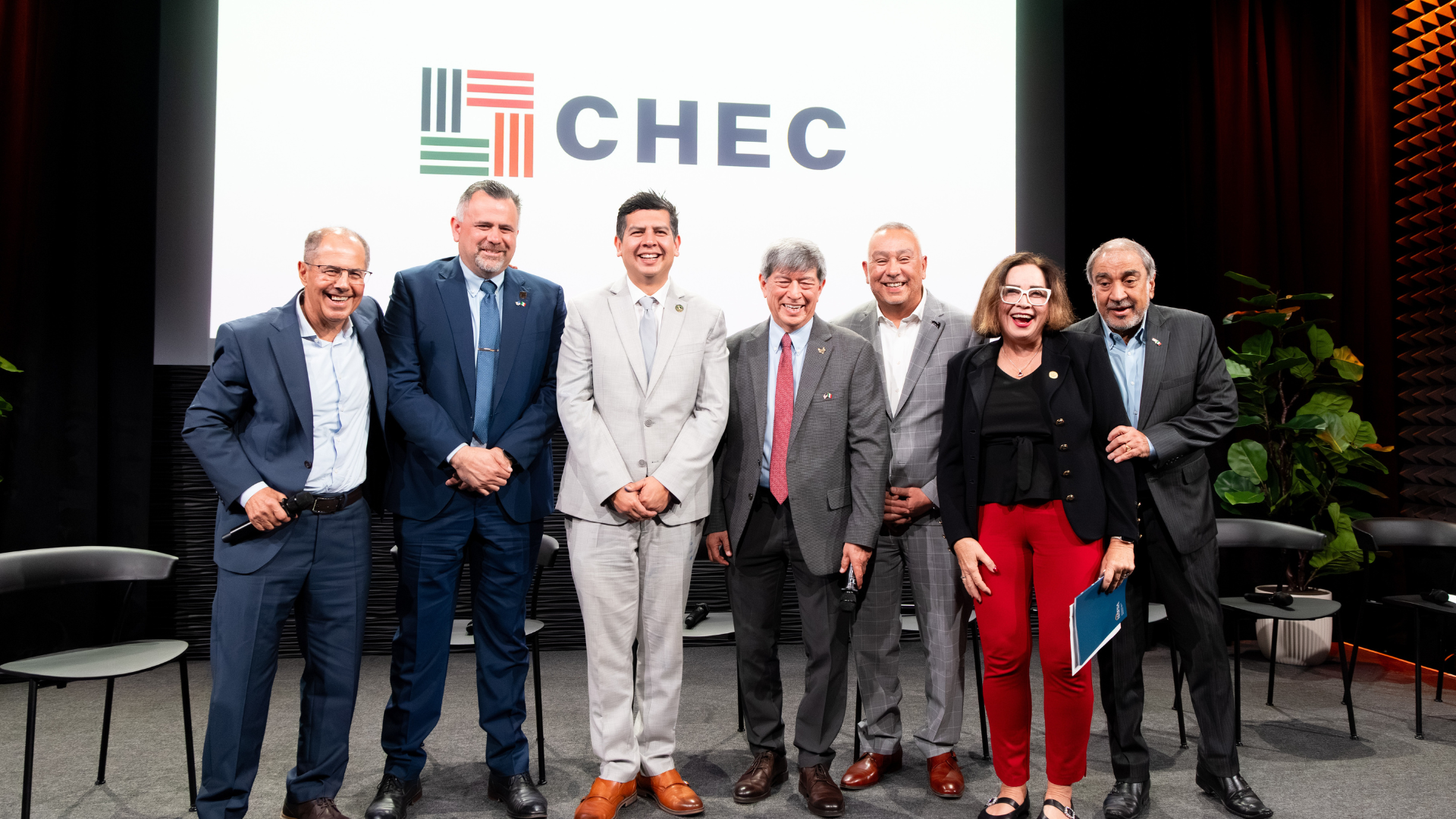
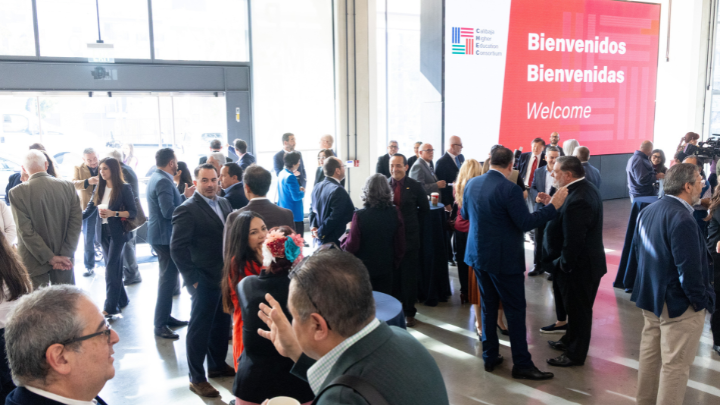
Top higher education institutions in San Diego and Baja California, along with government and industry leaders, launched a new consortium on Dec. 12 aimed at strengthening the binational workforce and advancing cross-border collaboration and innovation.
The CaliBaja Higher Education Consortium (CHEC) seeks to institutionalize transborder academic collaboration in one of the most interconnected border zones in the world, stretching from San Diego and Tijuana in the west to Calexico and Mexicali in the east.
The region is home to 7 million people and roughly $70 billion in goods and services flow across the border each year. Its $250 billion in annual economic output would put it near the world’s top 10 largest economies. The goal of CHEC is to build on an already strong foundation of education and research for a more competitive and prosperous region.
SDSU joined 16 other institutions in signing a Memorandum of Understanding to pursue CHEC’s mission, which could result in cross-border joint-degree programs, an improved financial pathway for student mobility and binational research, and a stronger regional workforce.
“I have been at SDSU for eight years and seen the profound need and opportunity for cross-border collaborations,” said SDSU president Adela de la Torre. “With this consortium, we are planting the seeds for partnerships that can unleash the region’s vast potential as a binational powerhouse, and where – together – we generate solutions to the region’s greatest challenges.”
Joining SDSU in the consortium from the U.S. are the Southwestern Community College District; University of California, San Diego; and the University of San Diego. Members from Mexico include the Autonomous University of Baja California, CETYS University, El Colegio de la Frontera Norte, Universidad Iberoamericana, and Universidad Tecnológica de Tijuana.
“As I think about society for the next 20 or 30 years, the most important thing a university can do is find a way to reduce poverty in our society and increase equitable wealth generation and distribution,” said Pradeep Khosla, chancellor of UCSD. “So I can imagine that this consortium could become a primary driver of wealth generation in this region, both for Mexico and the U.S.”
Also on board are the U.S. Consul General in Tijuana, the Consul General of Mexico in San Diego, California Assembly Member David Alvarez, the Baja California Secretary of Education, the Center for U.S- Mexican Studies, Smart Border Coalition, Tijuana Innovadora Binacional, and Border Philanthropy Partnership.
“What is it that we really want to do? It’s to think about binational education in a fundamentally new and innovative way,” said Chirstopher Teal, U.S. Consul General in Tijuana. “It is really about going beyond the traditional model of student exchange and thinking about transferring credits, having dual degree programs, sharing curriculum that we need in new fields, and it’s about lifelong learning.”
Today’s political landscape is shifting, said Alicia Kerber-Palma, Mexico’s Consul General in San Diego, and with that comes the opportunity to position the CaliBaja region as a hub for knowledge, innovation and shared talent.
“Higher education is one of the most powerful tools that can help us build trust, stability and cooperation, three areas so much needed in these times,” she said.
State Assemblymember David Alvarez, D-Chula Vista, has championed recent legislation to expand binational education. One such bill allows California State University system schools to award joint undergraduate, graduate and doctoral degrees in partnership with universities in Mexico. SDSU is in the early stages of pursuing such programs.
“We are working in really good ways through academic programming, through finding partnerships that didn’t exist, through giving authority to different institutions to do things like joint degree programs or accepting students from Mexico in community colleges,” said Alvarez.
Alvarez also championed AB 91, a five-year pilot program that allows low-income students living in Mexico to attend community college in San Diego and Imperial counties at in-state tuition rates instead of much higher international student rates.
According to Cristina Alfaro, SDSU associate vice president of International Affairs, “The CaliBaji Higher Education Consortium, at its core, is about diplomacy, authentic relationships, collaboration, exchange of ideas, and innovations to make our already vibrant region even better.”
SDSU will host the first meeting of 2026 for the CaliBaja Higher Education Consortium on Feb. 6th at 9:30 a.m. in the Parma Payne Goodall Alumni Center. Topics will include mission and objectives, accreditation and mobility, talent development, legislation and governance.