A year of achievement at SDSU: 2025 in review
Recognition for exceptional research, partnerships with community colleges, athletics accomplishments and record fundraising were parts of the university’s continued momentum.
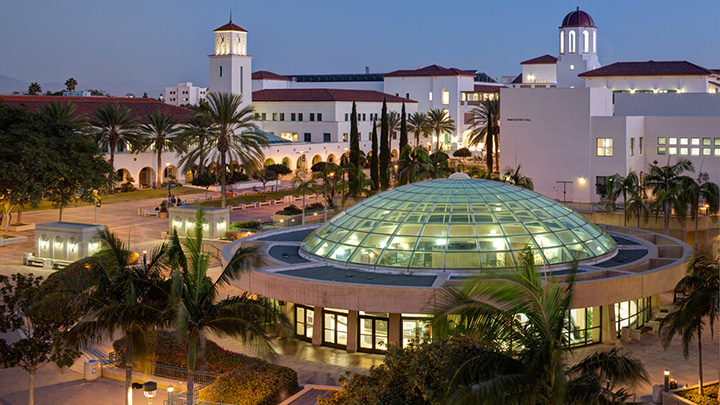
As 2025 draws to a close, San Diego State University looks back on its continuing accomplishments in research, its importance as an economic powerhouse for the region and state it serves, and the value of the undergraduate, graduate and doctoral degrees it awards in a 128-year legacy of public higher education.
Here are some of the year's top stories:
We’re R1
For decades San Diego State University has been a standout in academic research, attracting talented investigators from around the world who are at the top of their fields, creating opportunities for undergraduate and graduate students alike to contribute to high-quality work with experience in the lab, and drawing grants from such agencies as the National Science Foundation, NASA, the National Institutes of Health and the Department of Defense.
In February, SDSU achieved R1 status, based upon its high level of research activity and doctorate production. The designation from the Carnegie Classification of Institutions of Higher Education places SDSU into the top 5% of research universities nationwide. The recognition is expected to draw even more leading researchers and industry partners, along with new opportunities for grants and research contracts, further elevating the university’s reputation and the value of every SDSU degree. The achievement aligns with SDSU’s Strategic Plan, which set out to achieve R1 status during its first phase.
“R1 universities are economic engines in their states and regions, with teaching, research and innovation that foster entrepreneurship, and lead our graduates to prosperous jobs through partnerships with industries and government entities,” SDSU President Adela de la Torre said at the time of the R1 announcement. “It recognizes and supports more opportunities for our students, more breakthroughs from our researchers and more ways to serve our communities.”
Read: SDSU earns R1 classification, joins top 5% of research universities in the U.S.
Achievement by the numbers
It was a record-setting year for SDSU students.
Combined enrollment at SDSU and SDSU Imperial Valley reached 41,184 in the official fall census, up 4.6% from the previous year. This included 6,911 first-year students, admitted from a pool of 95,444 first-year applicants and more than 123,000 overall ― all school records.
Nearly 11,200 students graduated in May 2025. SDSU exceeded the California State University’s systemwide goals in its recently concluded Graduation Initiative 2025, with particularly notable growth in the four-year graduation rate. Equity gaps continued to close with a first-year retention rate of 91.5% for historically underrepresented ethnic groups, up from 87.4% a decade ago and now actually a tick higher than the 91.2% retention rate for other student groups
Read: University census confirms record-breaking SDSU, SDSU Imperial Valley enrollment for 2025-26
Donors Set New Records in Giving
SDSU’s endowment, a vital and ongoing source of funding for student success programs, scholarships, research and other ongoing needs, passed the half-billion-dollar mark for the first time amid a record-breaking year for general fundraising as well.
Donors contributed more than $142 million in the 2024-25 fiscal year, a 9% increase from the previous year, which had also set a new record, with 70 individual endowment funds established. Day of Giving, an annual campaign, also set a record in March, raising $487,984 overall from 1,350 donors.
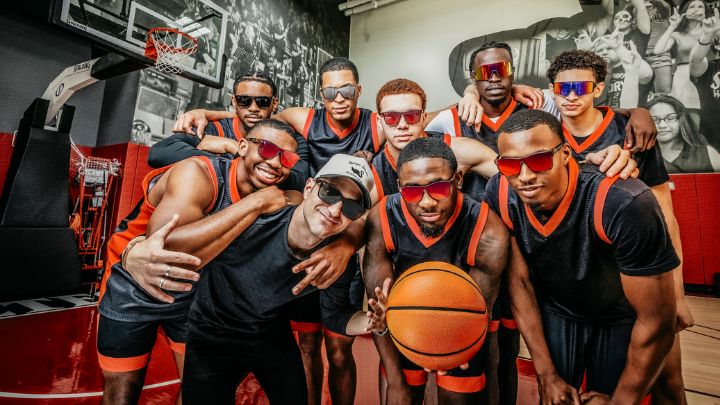
Notable gifts: Alumnus and eyewear entrepreneur Chase Fisher pledged $5 million toward the men’s basketball program to support recruitment and retention of top players. A $3 million endowment to create the Peter J. and Elaine R. Shaw Family Center for Experiential Learning at the Fowler College of Business was announced this month. Finally, an endowed chair faculty position in SDSU’s construction management program was created through a $2.5 million gift from the San Diego chapter of Associated General Contractors and its member businesses.
Read: Donors contributed more than $142 million in a record-breaking year for SDSU fundraising
Read: $5 million gift ‘a transformative moment’ for Aztec men’s basketball
Read: Endowed chair established in construction management
A powerful economic impact
Released last month, “Moving California Forward: The Economic Power of the CSU” reported on the value of degrees from all 22 campuses across the California State University system, and the economic vitality they pour back into the state. SDSU was the system’s top performer in many metrics.
For its students and alumni, SDSU provides value in the form of an earned degree they carry through life. The average graduate earns more than $500,000 in present-value earnings over their career compared to peers without a bachelor’s degree, while SDSU’s more than 500,000 alumni earn a collective $5.3 billion in additional income attributable to their degrees, the report said.
To the region and state, the university is a nearly $10 billion-a-year economic engine of workforce development, higher earning power, industry activity, tax revenue and additional societal impacts that drive opportunity and economic growth. The 26,000 jobs supported by SDSU statewide, which is the most of any CSU institution, generate nearly $240 million a year in state and local tax revenues. And for every dollar the state invests in SDSU, it gets back $12.66 in statewide industry activity. Add in the enhanced earning power of SDSU alumni, and that figure jumps to $38.28 per dollar invested.
Read: San Diego State University’s enduring economic impact
Read: Moving California Forward: The Economic Power of the CSU
Grants propel high-powered research activity
Even amid cutbacks at the federal level, grants and contracts propelled high-level research at SDSU in the year it was recognized as an R1 Institution. Funding from all sources, public- and private-sector, came in at just over $200 million for 2024-25.
Among the high-profile grants were $1.2 million from the W.M. Keck Foundation for research in the College of Engineering on materials processing, and a $1 million grant from the San Diego-based Prebys Foundation for STEM-related research.
The U.S. Department of Education awarded $30 million to the College of Education over five years to support the creation of the National Vocational Rehabilitation Technical Assistance Center. The College of Engineering received a $4.5 million award from the National Science Foundation to develop a certificate program and master's degree linked to innovations in AI and robotics being used in modern construction.
And at SDSU Imperial Valley, a $5 million federal grant for the newly established Prevention Research Center will address a regional issue of great interest: extreme heat exposure and related health disparities in Imperial Valley.
Read: From the tiniest units of time and matter, a mighty grant for SDSU
Read: Research and Philanthropy: How private support can help fill a gap
Read: Major NSF grant seeks to fill 'skills gap' in construction engineering
Read: $30 million federal grant cements SDSU’s national leadership in vocational rehabilitation
Read: SDSU awarded $5 million federal grant to combat extreme heat in Imperial Valley
Physical transformations
SDSU Imperial Valley celebrated the August grand opening of its new Sciences and Engineering Laboratories in Brawley, designed to meet the region’s growing needs in STEM fields in the state’s “Lithium Valley.”
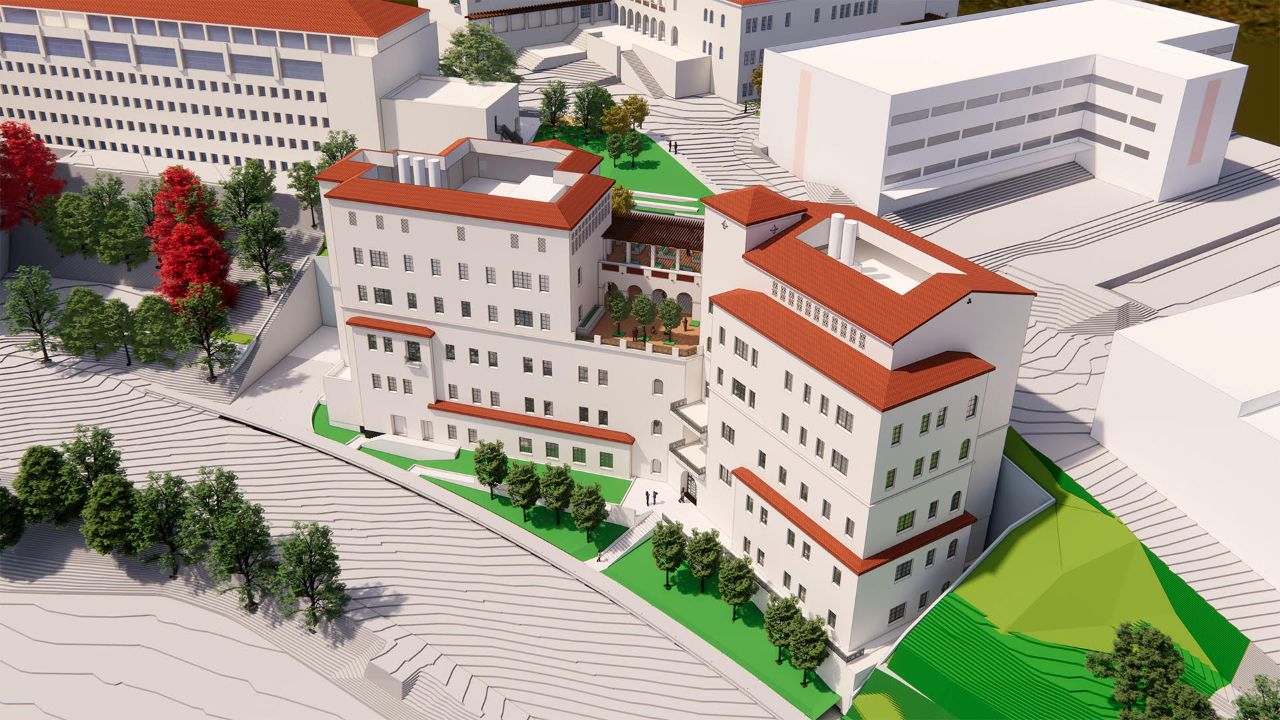
In San Diego, one of the charms of walking the campus is the ability to walk from buildings still standing from its 1931 opening to others, mere footsteps away, where the first coat of paint is still fresh. The latest capital improvements included the launch of construction on a building also dedicated to STEM instruction and laboratory sciences. Located on the northeast corner of SDSU, along Canyon Crest Drive and just northwest of the Chemical Sciences Laboratory, it will replace North Life Sciences upon completion in 2027.
Construction also began for the first residential and retail development in SDSU Mission Valley. Two student housing developments also got underway: SDSU’s Evolve student housing, to be built in phases for a net gain of about 4,500 beds in San Diego, and a joint project of SDSU Imperial Valley and Imperial Valley College for 40 single- and double-occupancy rooms in Calexico, on track to open next fall.
Read: SDSU approved to begin construction on new building for STEM
Read: SDSU Imperial Valley celebrates grand opening of its Sciences and Engineering Laboratories
Aztec iconography ties into past, present
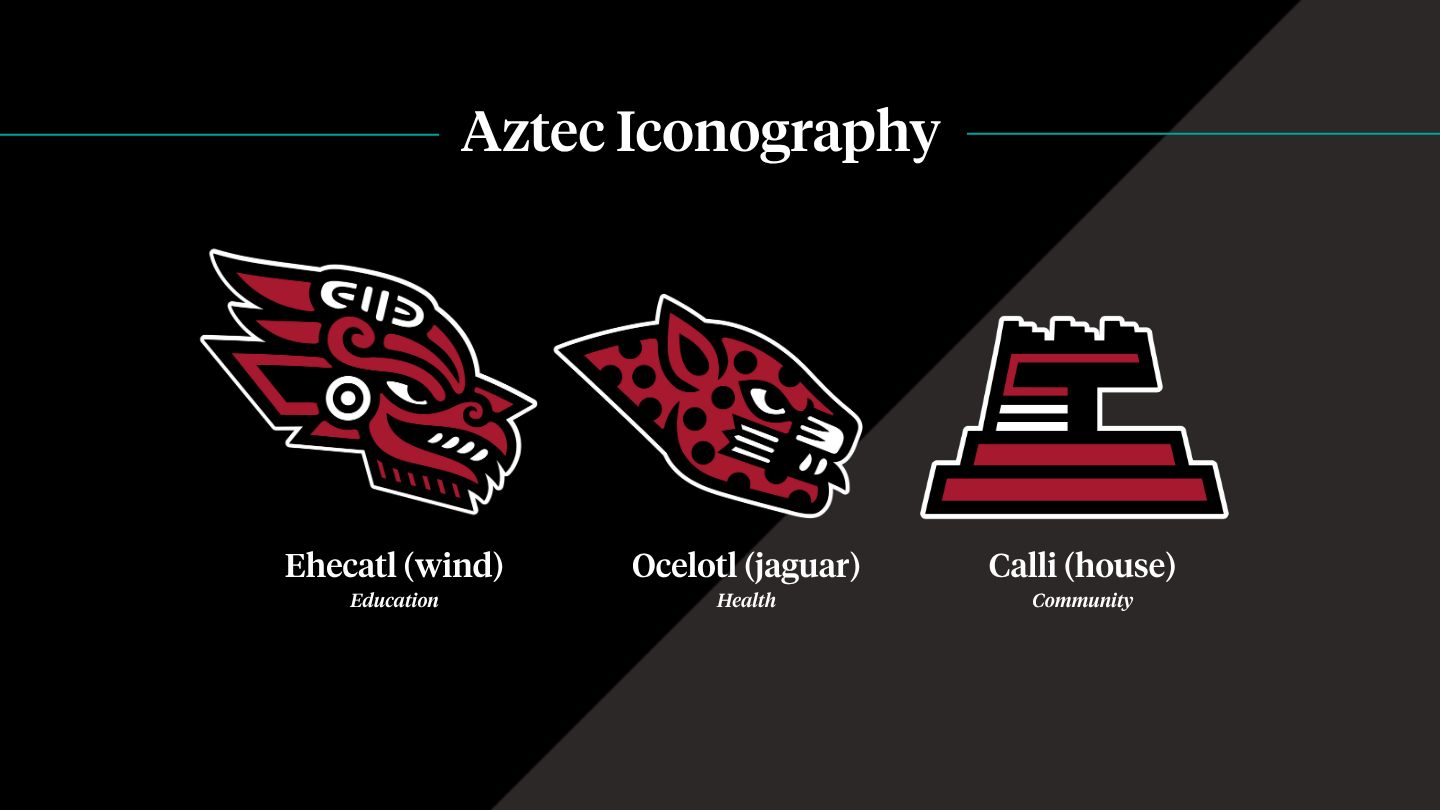
SDSU Athletics in October unveiled three new “glyphs” – new visual representations of its Aztec identity, to honor and deepen its ties with Aztec history and culture.
The iconography is the product of years of consultation with Mesoamerican scholars, as well as an artist from Coahuila, Mexico, to expand SDSU Athletics’ visual identity with a meaningful connection both to the past and the university’s core values.
Familiar to anyone who has studied the widely admired Aztec football helmet and based on the Aztec Sun Stone created in the 15th century, the three selected glyphs, are:
- Ehecatl (Wind): Representing Quetzalcoatl, the feathered serpent, god of intelligence and self-reflection. Linked to the value of education.
- Ocelotl (Jaguar): Representing Tezcatlipoca, god of the night sky, memory, and time. Linked to health and perseverance.
- Calli (House): Representing Tepeyollotl, god of animals, caves, echoes, and earthquakes. Linked to community involvement and connection.
Read: SDSU unveils glyphs, expanded Aztec iconography honoring Aztec heritage
Nursing programs address critical shortage
The launch of four Doctor of Nursing Practice (DNP) programs underscored SDSU’s commitment to expanding advanced nursing education to meet a growing statewide and national need.
Three nurse practitioner programs ― family nurse, adult gerontology primary care, and psychiatric-mental health ― and a post-master’s DNP will expand opportunities for nurses to advance their practice in one of SDSU’s most high-demand fields.
“When nurses graduate with these advanced degrees, patients and families benefit directly,” said Karen Macauley, director of the SDSU School of Nursing. “They are cared for by professionals who not only bring clinical expertise, but also the ability to turn the latest evidence-based practice into practical solutions.”
Read: SDSU launches four new nursing programs to address critical healthcare needs
Community college partnerships
Expanding partnerships with Southwestern College (SWC) in Chula Vista and the San Diego Community College District (SDCCD) show the growing importance of highly accessible and affordable community colleges as seamless feeders to the four-year California State University system.
Beginning fall 2026, Southwestern transfer students can complete an SDSU bachelor’s degree in psychology with core major classes, plus industrial/organizational psychology and neuroscience courses, through in-person and online offerings right at SWC’s University Center in Chula Vista. The courses are seen as particularly relevant to careers in human resources, organizational development and workforce analytics, and to roles in such high-demand fields as health care, education, government and technology.
Meanwhile, a guaranteed transfer admission program for students from San Diego City, Mesa, and Miramar colleges ― the SDCCD’s three credit colleges ― begins in fall 2026 for applicants meeting specified requirements. And a memorandum of understanding, signed in July, outlines plans to develop a shared, STEM-oriented academic building in the SDSU Mission Valley Innovation District, a space designed to house education, research and industry partnerships.
Read: SDSU, Southwestern College expand educational access through new University Center partnership
Athletics achievements
An at-large spot in the First Four round of the NCAA men’s basketball tournament last March marked a fifth consecutive NCAA Tournament appearance and the sixth in eight seasons under head coach Brian Dutcher. Women’s basketball, coached by Stacie Terry-Hutson, qualified for the tournament as well.
In a comeback year for men’s football, the Aztecs’ 9-3 overall record this season (undefeated at Snapdragon Stadium) resulted in an invitation to the Isleta New Mexico Bowl, to be played Dec. 27 in Albuquerque.
Notably, men’s basketball, women's tennis, men's golf, women’s swimming and diving, and women's softball all produced Mountain West championships.
SDSU Athletics continues to excel in supporting its student-athletes. All 18 athletic programs at SDSU exceeded NCAA Academic Progress Rate (APR) standards, with two women’s teams, basketball and golf, recording a perfect multi-year APR score of 1,000. Nine programs earned perfect single-year scores, tying a school record.
Read: It’s Aztecs vs. North Texas Mean Green in Isleta New Mexico Bowl