How machine learning helps students stay on track toward graduation
Richard Levine will deliver SDSU’s 2026 Albert W. Johnson Research Lecture, exploring use of data science to support student success.
Success in introductory or prerequisite courses can play a major role in shaping a student’s academic journey. When an early course proves challenging, it can reduce the pace at which students move through their degree programs.
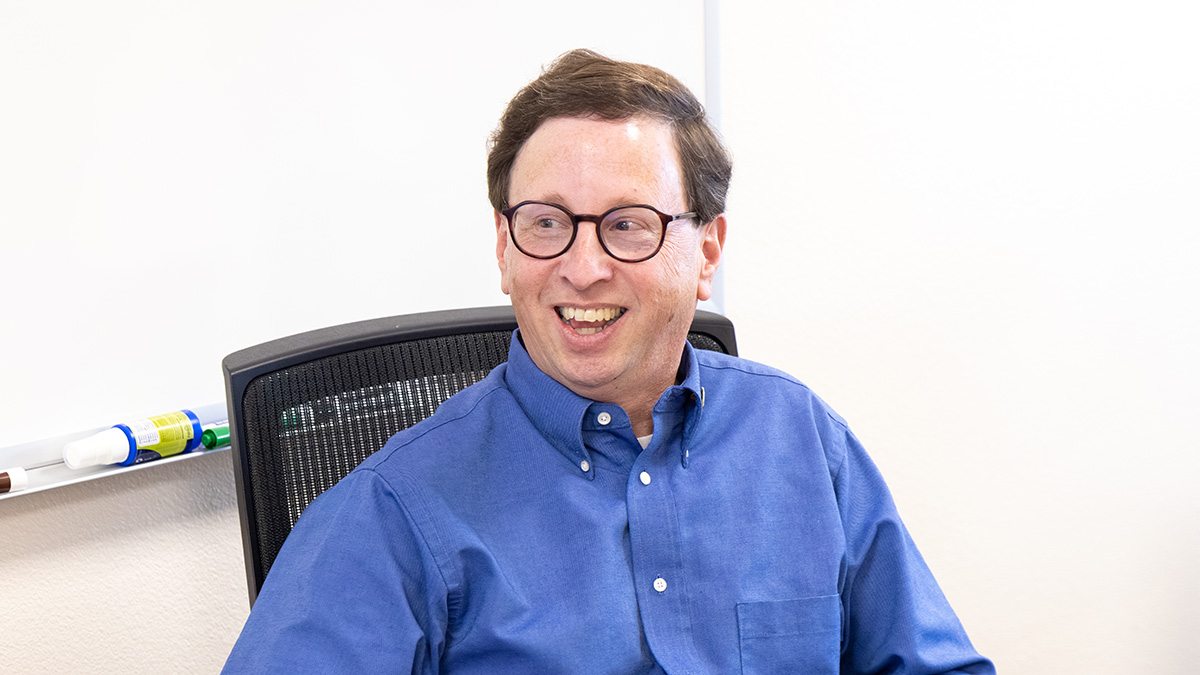
Students may face a variety of hurdles in the classroom, and those challenges look different for everyone. That is what motivates Richard Levine, professor of statistics within San Diego State University’s College of Sciences, who develops machine learning techniques proven to keep students on track for graduation.
Levine was nominated by colleagues and selected by a university committee to present the 35th annual Albert W. Johnson Research Lecture at 3 p.m. March 24 at the Parma Payne Goodall Alumni Center. The lecture is free and open to the public; an RSVP is requested and can be submitted online.
To determine the likelihood of students succeeding in a particular course, Levine gathers data on their past performance in similar subjects, along with results of a placement exam assessing their current skills. He also helps track student performance throughout the semester, evaluating how scores on assignments or exams predict their overall success in the course.
Using machine learning tools to evaluate this data, Levine builds a tailored roadmap for each student. Results suggest which forms and frequency of educational support, such as tutoring, supplemental instruction or instructor office hours, would most help a student improve their grades.
“We guide advisors and instructors on combinations of programs students might use to make sure they stay at SDSU, and successfully progress through their programs of study toward graduation,” Levine said.
The results have been exemplary.
“We had a very low success rate. Some semesters was 30, 40% failure rate,” Levine said. “We're now down to about 15%. We definitely saw an improvement in time to graduation, just by improving performance in key pre-requisite courses.”
Making adjustments
Departments can also use this data to spot trouble areas in course curriculum and adjust accordingly, to allow for better classroom experiences.
“In medicine, they tell us we should always go for checkups and keep on top of things,” Levine said. “We have all this data, so it's preemptively making sure students are staying on track and telling them how they can succeed in the course.”
In 2023, Levine co-founded the Southern California Consortium for Data Science which aggregates student success data from schools in the California State University, University of California and community college systems. This provides a comprehensive view of California students’ performance in data science courses, to promote more effective higher education practices.
“We share success stories. We discuss challenges,” Levine said. “It's this shared learning environment where we can come up with curricula and lesson plans and programs that will help students succeed as they head into the workplace.”
Whether it’s in the classroom or his research group, Levine believes students must “get their hands dirty with messy data” to be prepared for jobs that require real-world problem-solving.
“I think it's really important for data science students to be embedded in research teams so they learn what data we have available, questions we can ask, anomalies we have to address,” Levine said. “My research students learn how to interactively develop machine learning tools with experts, and communicate findings to key stakeholders to actually make a difference.”
Over his career, Levine has received about $7.3 million in external research funding as a lead investigator on projects, working closely with other SDSU researchers across a variety of disciplines, as well as global experts in subjects such as education, medicine, the environment, finance and sports. He plans to publish a new statistical computing textbook in 2027.