Student teacher standouts in Imperial Valley will keep their classroom skills close to home
Awardees Lizbeth Figueroa and Jacqueline Santana, part of a cohort of 57 graduates of the SDSU Imperial Valley Division of Education, want to have an impact in the region where they earned their credentials.
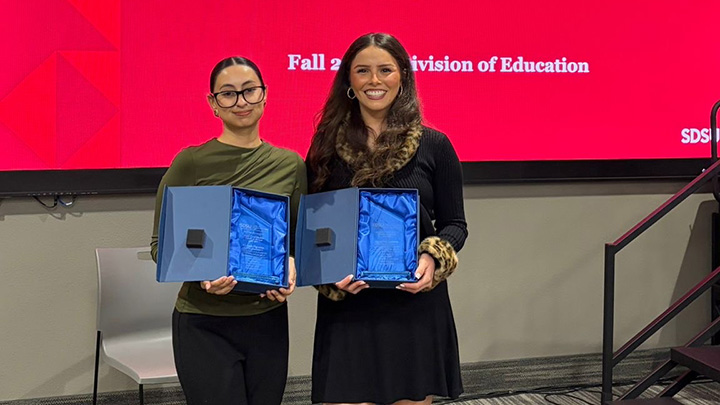
Lizbeth Figueroa remained quietly seated when her name was announced, thinking she was a nominee. Then, when a friend firmly nudged her, and the applause kept going, she realized she had been selected from a cohort of 57 graduates as one of two Student Teachers of the Year awardees at the SDSU Imperial Valley credential ceremony on Dec 8.
“I was completely shocked, but happy when I figured out what just happened,” Figueroa said, as she accepted the award for student teaching in a single subject at Calexico High School — the same school she once attended and was inspired to become a Spanish language teacher.
Figueroa knew she wanted to teach since first grade. She earned her bachelor’s in Spanish at SDSU Imperial Valley and was accepted into the credential program.
“I’m bilingual, but was really shy about public speaking,” Figueroa said. “Now, I’m open to going anywhere, standing up in front of a class and teaching advanced Spanish to teens,” she said.
In contrast, Jacqueline Santana, who was also awarded Student Teacher of the Year in multiple subjects for her student teaching at Miguel Hidalgo Elementary School in Brawley, said she discovered her passion for teaching in college.
“I picked up a job at an after-school program, and fell in love with helping kids, and the chance at making a lasting impact in their lives changed mine,” Santana said.
Born and raised in Imperial Valley, Santana earned her bachelor’s in liberal studies at SDSU Imperial Valley. She said she chose the credential program there because it is affordable, convenient, and it prepares educators to work in most states.
“I’ll be staying and working in Imperial Valley,” she said, “I want to give back to my community and make a lasting impact on the next generation.”
Walter Lewis, student teacher coordinator, Division of Education, SDSU Imperial Valley, said most credentialed teachers find positions in Imperial Valley or elsewhere in California, some choosing to teach in communities that have trouble attracting fully credentialed teachers.
“In a state that still faces persistent teacher shortages, especially in rural and border regions, every one of these graduates helps close that gap for California’s K-12 students,” Lewis said.
The SDSU Imperial Valley Division of Education’s accelerated credential program is intentionally designed for working adults, and many are already deeply connected to the Valley community. Most credential candidates work full-time during the program’s first two semesters, and classes begin after 4 p.m. to accommodate work and family responsibilities
During the final third semester, students transition into a full-time, 16-week, residency-style internship, teaching a total of 600 hours to meet California’s credential requirements.
“It’s a really condensed program, so instead of spreading student teaching over multiple terms, they do that work in one intense semester — and when you add lesson planning at night and on weekends, most of them are going well beyond the required hours,” Lewis said.
Workforce impact
Behind the scenes, Lewis said, an individualized approach helps candidates manage the demands of work, school and family, while preparing them for job offers they may get while still in the program.
“That level of personal attention is one of the things that sets our program apart,” Lewis said. “Sitting down with our students in one-on-one meetings to help them navigate schedules and academic milestones makes all the difference in whether someone can complete the credential program and ultimately become a teacher that meets community needs.”
Over time, Lewis has also seen SDSU Imperial Valley credential graduates strengthen the region by becoming classroom teachers and serving on local school boards. . Today, he said, many teachers and administrators share the same cultural and rural backgrounds as their students, offering representation and role models that were largely absent when he began his career.
“SDSU has played a significant role in changing the educational structure of schools in Imperial Valley,” Lewis said. “Most of our students speak Spanish and English, and many earn a bilingual authorization with their credential, which is incredibly valuable in a state that needs more bilingual and special education teachers in high-need schools.”
Figueroa plans to pursue her bilingual authorization while teaching Spanish once she secures a full-time teaching position. Santana said she’s returning to a position as an early reading interventionist, until she lands her dream teaching position in Imperial Valley.
“Teaching has unlimited potential to make a lasting impact across generations,” said Santana. “If you help just one student achieve their dream, they will pass that impact along to the next person.”
Guillermina Núñez-Mchiri, dean of SDSU Imperial Valley, said the awardees embody the mission to expand educational opportunity and support the region’s workforce needs.
“Our student teachers are deeply connected to our communities and committed to making a difference,” Núñez-Mchiri said. “Jacqueline and Lizbeth are a great example of how well this program prepares future educators to lead with compassion, creativity and cultural relevance.”
SDSU Imperial Valley’s Credential Program is now accepting applications for fall 2026. The program offers Multiple Subject and Single Subject credentials and Bilingual Authorization. Students must also submit a California State University application by the Feb. 1, 2026 deadline to be considered.