CSU selects engineering professor for outstanding faculty award
Chunting Chris Mi is internationally recognized for his work advancing EV technology. Locally, he’s known for helping businesses cut their utility bills.
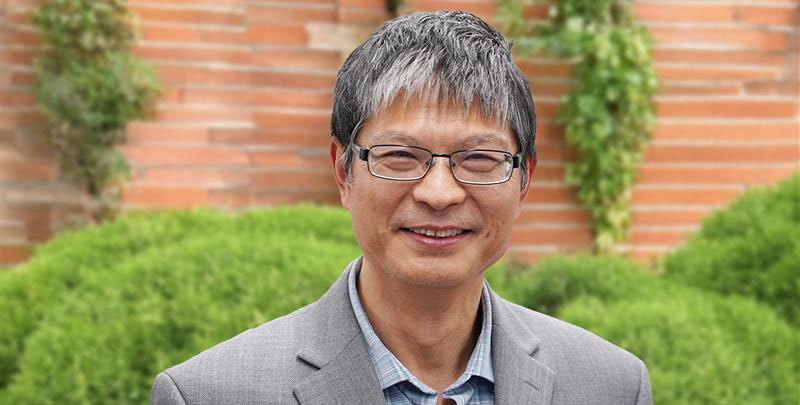
It’s testimony to the importance of the research going on in Chunting Chris Mi’s San Diego State University engineering lab that some students have snagged jobs at such companies as Apple, Tesla and Ford, while others have gone on to teach, both in the U.S. and overseas.
Helping to curb climate change and train the next generation of engineers, the lab is the focal point of Mi’s breakthroughs in improving electric vehicles for the mass market, protecting the power grid from cyber attacks, and reducing electricity bills for businesses.
“Most students are very excited about what they do,” said Mi, newly recognized with an award from California State University. “Most of them actually stay in the field.”
Mi, an Albert W. Johnson Distinguished Professor in the Department of Electrical and Computer Engineering, heads the Cai Li and Daniel Chang Center for Electric Drive Transportation in the College of Engineering, originally established in 2011 with a grant from the U.S. Department of Energy. He was among four CSU faculty members and an administrator honored Tuesday by the CSU Board of Trustees with the Wang Family Excellence Award; Mi was selected for this year’s Outstanding Faculty Scholarship.
“What we do helps the environment, and it helps reserve resources for our future generations,” Mi said last week in an interview in his office on the fourth floor of the Engineering building.
“We really make things more efficient, safer, and more reliable. That’s all good.”
Ongoing work in Mi’s lab (much of which is in conjunction with other academic departments) includes:
- Wireless charging systems for EVs to make charging faster, more efficient and cheaper. His circuit design has been recommended by the Society of Automotive Engineers for use as an international standard.
- Extending the life of EV batteries to provide power for energy grids, a project supported by a $2.83 million grant from the California Energy Commission, which has the added benefit of reducing the burden on recycling.
- Advanced algorithms to mitigate cyber attacks on power grids and make them more resilient, supported by a $1.5 million National Science Foundation grant.
Onsite energy generation and storage has become another centerpiece of Mi’s work and has become increasingly important, he said, at a time utilities have shut down power during periods of heavy demand. “If you have more of your onsite generation, whether it’s from solar or from fuel cells or from onsite energy storage, you can always shuffle your demand. It reduces costs, too. You can decide what time to use or not use the electricity from the grid.”
San Diego businesses using Mi’s energy storage systems have seen their electricity bills drop by as much as 30%, he said, recovering their investment in as little as four years.
Mi, whose research journal papers have made him one of the top 1% most highly cited authors in the world as measured by Clarivate, was nominated for the Wang Family Excellence award by Ping Lu, Distinguished Professor in the Department of Aerospace Engineering.
“His scholarship has achieved global recognition,” Lu wrote. “His innovations … exemplify how CSU research drives technological advancement, student success and societal benefit.”
The Wang Family Excellence Awards were established in 1998 through a donation from then-CSU Trustee Stanley Wang, and endowed in 2017 with an additional donation.
“The CSU’s extraordinary and far-reaching impact is possible only because of the people who bring our mission and core values brilliantly to life," Chancellor Mildred García said in a statement. "The work of the five extraordinary individuals we honor this year is as inspiring as it is consequential—and it demonstrates why the CSU leads the future of inclusive excellence and social mobility."